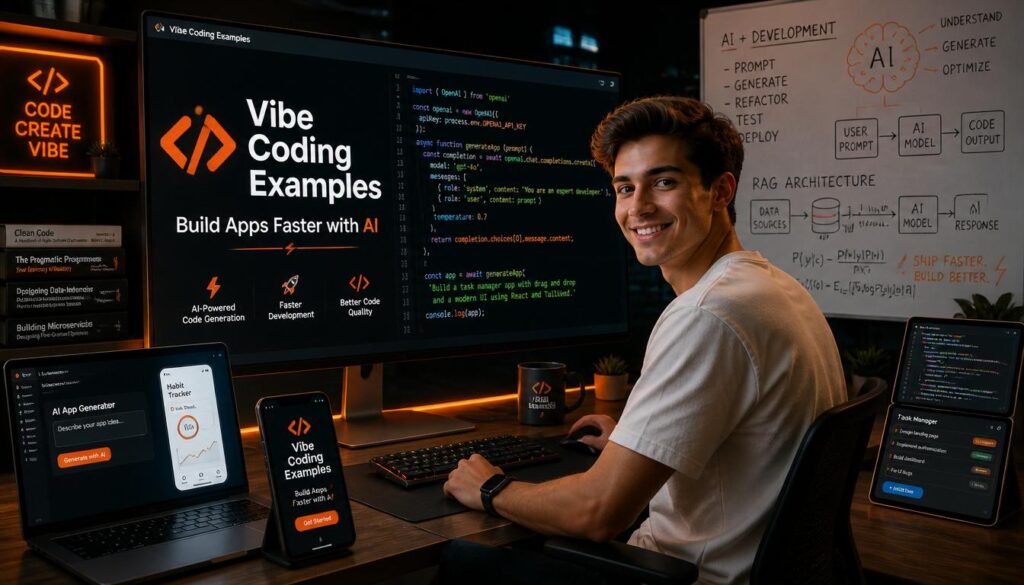
Vibe coding is a natural language software development tool that relies on AI to code. While many examples exist that demonstrate the ease at which workflow coding becomes automated, they also demonstrate the total lack of manual coding required by the user.
In 2025, the term “Vibe Coding” found its origin with OpenAI cofounder Andrej Karpathy. It refers to the process software developers use when they verbally communicate their objectives.
Most developers are familiar with the complications of creating a function from scratch or dealing with coding errors that may arise. Vibe Coding eliminates these hurdles. Users need only provide an AI Coding assistant with a prompt, review the response, and suggest modifications, if necessary.
Perhaps the most amazing aspect of Vibe Coding is that it can be, and has been, employed by people with little to no formal training in coding. It is not uncommon for product managers, designers, and non-technical founders to employ Vibe Coding to manifest their ideas. A Y Combinator 2025 report stated that 25% of the portfolio companies had AI-influenced codebases for their first versions.
These examples may serve as motivation to realize your potential, whether you are a diehard developer or someone who’s showing an interest for the first time.
Vibe Coding: What Is It?
Vibe coding inverts the traditional technique of coding. Instead of writing code and seeing if it produces the correct the result, vibe coding lets developers describe what the result should look like, and coding AI then generates the code that will yield said results.
Cursor, GitHub Copilot, Replit Agent, and Claude are just a few examples of tools that accommodate the vibe coding technique. Although they each have their unique functionalities, their central coding loop is the same: prompt, review, refine, ship.
Although the terminology is fresh, the capability it describes has been in development for a number of years now. LLMs, or large language models, that have been developed and trained on millions of lines of code are able to write fully functional and syntactically correct code in just about any language. By 2025, the major difference will be the rapid deployment of faster tools that will be better and even more easily integrated into a wider range of concepts.
Who Is It for?
Vibe coding is helpful for many users, although it certainly is not helpful for all. A few examples are as follows:
- Quickly prototyping solo founders and makers without the need to hire devs.
- Allowing devs to skip the boilerplate and focus on the architecture and logic.
- Enabling designers and product managers to experiment and validate ideas and concepts prior to a full build.
- Allowing beginners and hobbyists to code with a rapid feedback loop.
Vibe coding is particularly unhelpful in industries where the safety of the end user relies upon each line of code being manually and thoroughly validated, such as medical devices and financial systems.
9 Popular Coding Vibes Examples
Creating an Entire Web App From End to End Over a Weekend
Coding Vibe’s most popular stories include the lone wolf who creates usable web apps in less than two days. Using Cursor or Replit Agent, these devs explain the purpose, data model, and user flow for their apps in a chatbox. The scaffolding fills out the front end and back end for the database.
Specificity is critical. The more direct one is with their prompt, the closer the desired outcome. The task may read: “Build a task management app with user authentication, a Kanban board view, and the ability to set due date reminders”.
Making Your First Chrome Extension
Coding Vibe showed us that web apps and Chrome extensions were pretty easy to build with ChatGPT, GitHub Copilot, and a few other tools. You can find extensions that block web pages and summarize web pages.
Usually, this is done by explaining the extension and editing the auto-generated manifest.json and javascript files.
Making Your Life Easier With Python
Not every vibe coding example is a web app. The small ones are the simplest and most pragmatic. Using Python to automate tasks like data scraping, formatting wacky spreadsheets, and tasking to send emails.
For non-developers, this opens new avenues. A marketing analyst can now provide a prompt to create a data aggregation script, rather than having to rely on engineers to do the tedious task.
Constructing a Personal Finance Dashboard
The indie hacker community has made great strides building personal finance dashboards using vibe coding. By integrating public APIs or importing CSV exports from banking apps, they have the ability to create their own dashboards to trace spending with graphical representations and highlight transactions that deviate from the norm.
This example shows customization, a major benefit of vibe coding. Traditional finance apps include features at a compromise. A vibe coded dashboard can include whatever features are required without any compromise.
Prototyping a Mobile App UI
Creatives have a knack for finding workarounds. Designers and product managers have been using vibe coding to create interactive prototypes that transcend static mockups. Using tools like Replit or v0 by Vercel, they can describe a screen and the subsequent actions, and a working prototype in either React or React Native is done for them.
The output doesn’t always go straight to production — but it’s a quick and efficient way to validate a concept without a full development team.
Constructing a Business Dashboard
Within a business, dashboards, admin panels, and reporting interfaces are essential, but can take a long time to construct due to the demands of the task and lack of visibility. Using vibe coding, constructing these dashboards has drastically decreased in time and cost.
One example of this is when a customer success team wishes to see client information pulled from a number of SaaS tools in one place. Give the data sources, describe how the fields should be laid out in a table, how the data should be filtered, and an AI assistant will do the rest.
Writing and Deploying a REST API
Making a REST API is one of the harder things a programmer must do; however, the structured nature of it makes it a good example to automate with a code generator. With tools like Cursor or Claude, developers have been able to describe data models and their desired endpoints and have received fully functional, documented APIs in response.
Using vibe’s coding workflow doesn’t eliminate the need for a code review in this instance. It does, however, allow developers to spend more time on edge cases and optimizing the API and less time on the initial build.
Building a Landing Page Without a CMS
V0 from Vercel and tools like it have allowed developers and marketers to go from written briefs to fully functional landing pages. With a description of the product and audience, stylization preference, and a description of the value proposition, AI can build a page and style it responsive with HTML/CSS and React.
This tool is great for running marketing experiments and A/B testing without having to bring an engineer to a full stop.
Designing Your Own Game
Game design is challenging, and yet, coding a simple 2D game is a fun challenge. Using ChatGPT and Claude, developers can create browser games reminiscent of arcade games or even create simple puzzles, and all they have to do is explain game mechanics in plain English.
Building the game requires iterative processes (often involving many test runs). These runs involve loading the game, explaining what did not go rdone, and then adjusting even further. The development focus is on fun rather than a polished game.
Vibe Coding: Better Output, Better Input
The output even depends on the prompt/how well the output is described. When vague prompts are used, the result is also vague. However, specific and well thought out prompts and requests lead to more reliable and better results.
To create better coding vibes, follow some of the practices below.
Define the stack. Describe or explain the software or library/framework combo and the programming language. An example of a better prompt is: create this in NextJS + Tailwind CSS + Supabase. A useful prompt is a web app.
Describe behaviors as well as features. An example of a better prompt is: create a login page that does an authenticate check and create a session that uses JWT to store the session and then redirect the user to the dashboard if they are authenticated.
Use small steps when requesting features. Describe each feature in your app as a separate prompt. Better tools = better app.
Helps grow deficiency. Are you novice to coding? A great way to help is get the AI to describe what the code does. Building your code understanding helps catch errors.
Limitations of Vibe Coding
Vibe coding can significantly speed up development, and while there are great benefits to using it, there are also some limitations that you should know.
There is no assurance for quality. When generating code with AI models, developer tools can produce code that is syntax or functionally correct, however, bugs and code and logic flaws can remain. As always, code review is a must. This is especially true when the code is for a client or for code that handles sensitive data.
For large and/or complex systems, AI tools do not have the ability to understand the overall view of a system, or how the individual components fit together. Software developers will have to step in to create and define high-level system sketches and describe the interrelation of the components.
Vibe coding is a great tool for fast prototyping, but as the tools and frameworks that we are building with AI evolve, so will the approaches to coding. The best way to develop that skill is to use AI tools for coding.
Pick a paper prototype or a small project that is self-contained, and use AI tools to generate code for that project. Review, test, debug, and iterate that code to create a working first version of your prototype. Get in the habit of using AI tools to generate code, review it, and iterate on it. This can be a great way to build your skill. The tools will continue to improve, and it is important to stay up to date with the latest innovations.
Vibe Coding FAQ
What exactly is vibe coding?
Vibe coding is a way of developing programs that relies on a natural language prompt given to an AI tool to generate working code. The word was created by Andrej Karpathy, who is a co-founder of OpenAI, in early 2025. Karpathy used the word to capture the idea of a developer creating a general idea of the task while the AI performs the task itself.
What tools will you expect in vibe coding 2026?
Some of the more commonly employed vibe coding tools in use include Cursor (an AI-driven code editor), GitHub Copilot (an AI-based in-VS-Code pair programmer), Replit Agent (an AI-based, browser-based coding environment), v0 by Vercel (a UI-generation tool), and Claude and ChatGPT (AI assistants that generate and debug code, among other tasks.) The Vercel tool is currently in a beta testing phase.
Will you need coding knowledge to vibe code?
You won’t necessarily need coding knowledge to vibe code, but it certainly makes the process easier. With the right tools, almost anyone can create an app and even a prototype. However, without the basics of programming knowledge to code, it becomes unnecessarily hard to work with AI to achieve the quality control to texture the AI-generated output.
Is vibe coding a viable approach to create an app that will run in production?
It is definitely possible to use vibe coding to generate the code required to create a production-ready app, but the code will almost certainly get generated with a significant quantity of bugs. It will also get generated with “bad code,” i.e., code that is not quite right, insecure, slow, and inefficient. For apps that will get used by a large number of end-users or will handle a large amount of very sensitive data, you will need to do a more thorough review and quality assurance.
In what ways does vibe coding differ from GitHub Copilot?
GitHub Copilot is an example of vibe coding in action, but vibe coding encompasses many different elements. Copilot, for example, presents code snippets as the user generates code step-by-step. In contrast, vibe coding might produce an entire application or feature from a single, detailed prompt in natural language, and continuous changes are made to the initial output. Code is not generated in incremental steps, but rather all at once based on the prompt.
What projects are best suited to vibe coding?
Short, self-contained projects. Examples of these projects are: landing pages, internal applications, REST APIs, browser extensions, data manipulation scripts, and prototypes. These projects are best suited for vibe coding, whereas large and complex projects are not, particularly due to the AI’s inability to fully understand and retain context over an extended period. Complex projects often require understanding beyond the current AI tools as they are.

I am Ray Jones Digital
My current occupations: a Digital Marketer, Local SEO expert, Link Builder, and WordPress SEO specialist. Shopify SEO, Ecommerce Store Management, and HTML & WordPress Developer I have been practicing the above mentioned services for more than 10 years now As an SEO expert working with your ongoing projects.